Diploma Thesis 2001
Biography
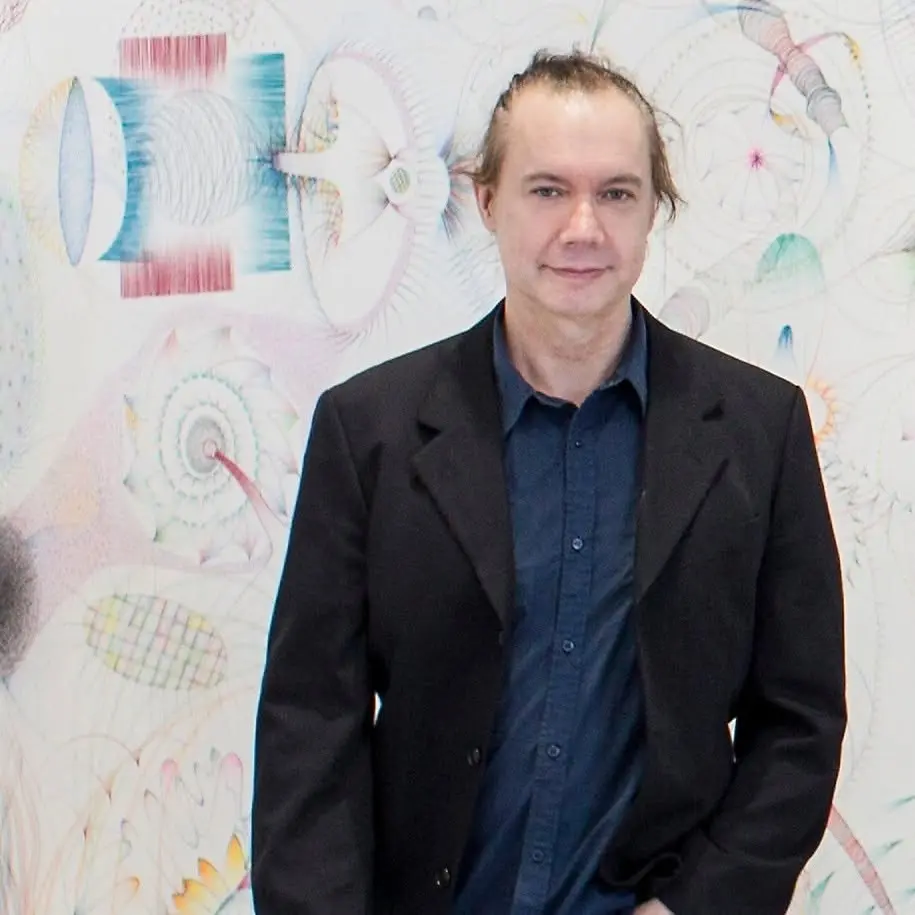
Harald Grünauer (b. 1968, Dornbirn, Vorarlberg) lives and works in Vienna. His practice unfolds like a carefully drawn map, not of places but of states: time, space, compression, forces, transitions. Looking at his work, you quickly sense that he is not searching for “a motif” but for an order beneath appearances. Grünauer does not draw to describe. He draws to make visible how something acts.
What may at first seem like very different phases of work follows a consistent inner logic. The subjects do not change so much as the viewpoint shifts. At times, the political reality of a system comes into focus; at others, the physical nature of a system takes over. A cycle might be told through images and video sequences, while later a field is built as a kind of line-architecture on paper. The continuity lies in method: precise observation, structured thinking, and a refusal to simplify complexity into easy statements. Instead, Grünauer translates it into a clear, rigorous form.
His drawings are constructions. Lines are not gestures; they carry tension. Layers are not ornament; they are time. The sheet is not a background but a spatial body—an instrument that absorbs forces, stores them, and releases them again as visible structure. The viewer is not confronted with an illustration but with a condition that gradually assembles itself through looking. This slowness is not an effect. It is part of the work’s integrity, and it is the price of density.
1. Formative Years: Learning to See, Taking Form Seriously
Grünauer’s artistic foundation was formed in the mid-1990s. A decisive impulse came from the International Summer Academy in Salzburg (1994), in the class of Georg Eisler. There, seeing was trained not as “pretty looking” but as psychological precision—attention to presence, to the gaze, to what is essential. This groundwork remains important even though Grünauer later committed himself to abstraction. Once you have learned to truly see, that seeing continues even when the figure disappears. He also attended the Vienna Art School (1994–1995), where drawing became a daily practice and a language in its own right.
From 1997 to 2001 he studied at the University of Applied Arts Vienna. Three positions became pillars of his thinking. Oswald Oberhuber reinforced a freedom of continual change and a distrust of fixed forms; style, in this sense, is not a home but a tool you can shift when the question demands it. In Gerda Fassel’s master class in sculpture, space became a physical reality—statics, volume, weight, balance. This influence remains visible because Grünauer thinks like a sculptor even on paper. He constructs spaces whose line-structures seem to carry their own gravity. With Brigitte Kowanz (diploma 2001), he found a decisive key: time, light, and coding as method—not as themes to be illustrated, but as principles to be shaped.
2. Key Work: “Water Cycle” (Diploma 2001) — Systems as Reality
His diploma project “Water Cycle” (2001) marks a singular milestone and reveals the breadth of his vision. Conceived as a multimedia narrative of video, photography, and drawing, it examines water as both a basis of life and a field of political conflict. Based on field research in Peru (Cusco/Chumbivilcas), the work avoids exotic storytelling and instead confronts concrete fault lines: pollution, climate phenomena such as El Niño, social inequality, and fragile infrastructure. The collaboration with the Universidad Nacional San Antonio Abad del Cusco, as well as Peru’s political context at the time, formed a resonance chamber for a work that remains grounded in reality while pointing beyond it.
What matters in “Water Cycle” is not simply the documentary material, but the movement of thought. Grünauer looks at cycles, transitions, and disruptions. He shows how systems can tilt, how memory can overlay images, and how time becomes tangible when organized through rhythm. In video modules such as “Agua Potable” and “Memory”—a layering of 180 images paced by the sound of a ticking clock—you can already sense his later central motif: time as compression rather than line. For this diploma project he received the Sussmann Foundation’s Award for Fine Arts (Vienna) in 2001.
Seen from this perspective, the later “cosmic” series are not an escape from the world. They are a shift within the same question: what happens when systems are understood not only socially, but physically—when you subtract events and focus on the forces beneath them.
3. Drawing at the Core: Recognition, Focus, Compression (2006)
In 2006 Grünauer’s drawing practice received further recognition through the Award of the Anniversary Fund of Dornbirner Sparkasse Bank AG. This acknowledgment coincides with a period in which his work becomes more concentrated. He increasingly moves away from the notion of the “single image” toward serial thinking, variation, and fields. Drawing becomes a form of thought. The motif is no longer central; what matters is the structure that makes a motif possible in the first place.
This is also when the long arc of his practice becomes clearer. A work is rarely a conclusion. More often it is the next step in a chain that stretches across years. This consistency makes the variety understandable: different phases are not breaks, but shifts in perspective within an ongoing system.
4. Public Space: Translation as an Artistic Attitude (EuroArt 2015)
In 2015 Grünauer carried his language into public space. As part of the EuroArt project in Vienna’s MuseumsQuartier, he transformed an iconic MQ-Hofmöbel (model “Viena”) into a sculptural image-carrier. What matters here is his approach. Grünauer does not decorate; he translates. He treats a functional object as an interface between everyday life and art. The intervention becomes a question of identity, material, sign, and surface. It shows that his work is not bound to paper, but to a method—thinking in structures.
This experience in the city does not stand in contrast to the large-scale paper works. It expands the vocabulary. It demonstrates that Grünauer’s art also holds in situations where people encounter it by chance—because the work does not demand explanation, but establishes presence. A quiet, concentrated presence.
5. Recent Work Groups: Time Machines, Spacetime, Particles and Fields
Since 2018 Grünauer has pushed his approach further in series such as “Time Machine,” “Spacetime,” and “Particles and Fields.” Here drawing becomes a measurement field. Time appears not as narrative, but as pressure—congestion, compression, density in space. In large-scale works on paper, sometimes reaching up to ten meters in length, a pictorial space emerges that recalls cosmological and physical models without ever illustrating them. The lines do not “talk about” science. They behave like science: testing, precise, consistent.
Grünauer is less interested in the spectacle of the unknown than in the exactness of thought. He aligns himself with logic, observation, and verifiable models. His images remain open, but never arbitrary. They are mysterious because they do not spell everything out, and clear because every line feels necessary. Paper becomes a zone in which forces are allowed to appear without being pictured. Space is not represented; it is built. Time is not told; it is layered.
That these bodies of work can look so different and yet flow into one another comes from the consistency of his working method. Grünauer works serially, over long durations, guided by clear internal rules. His development is not a series of jumps, but a process of compression. Each phase is another attempt to translate the same invisible reality into a visible order. This is how a body of work grows—expanding without losing its core.
Exhibitions & Collections (Selection)
Harald Grünauer’s works have been presented in institutional and project-based contexts as well as in group exhibitions, including Künstlerhaus Bregenz (“Time Machine,” 2019) and Bildraum Bodensee (“Fluid Universes,” 2019). More recent participations include the project “Kunst kommt vor Brot” (milk_ressort Göfis, 2025). His works are held in public collections including Artothek des Bundes, Vorarlberg Museum, the Illwerke vkw collection, and Sparkasse Dornbirn.